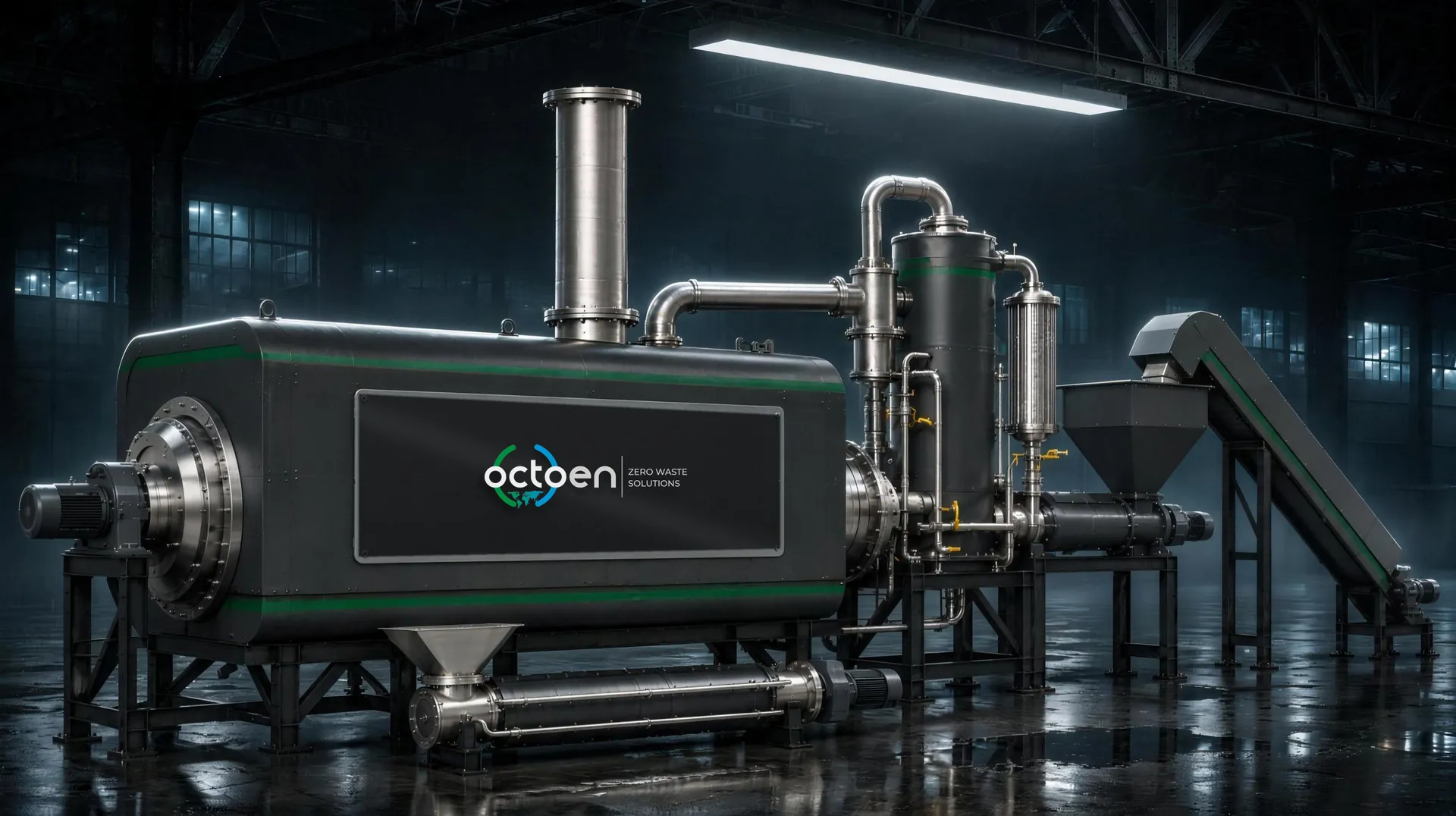
 Illustrative rendering. Final design and configuration may vary by project.
Continuous Biochar Pyrolysis System
Continuous, closed line
Wood waste in, biochar out. The line runs closed and, once started up, uses its own gas as fuel.
- Wood waste in, biochar out
- Runs on its own process gas once started up
- Closed water loops and PLC control
Added to your quote list. View quote list
How it works
From wood waste to biochar, in one closed line
The OCTOEN Continuous Biochar Pyrolysis System is a closed, continuous line that heats woody waste without oxygen and turns it into biochar. Material enters at one end and leaves the other end as cooled biochar. The combustible gas released in the process is not vented: it is collected safely and burned as fuel in the burners that heat the reactor. The flue gas from combustion is washed with water before it reaches the chimney.
- Raw material
- Biochar
- Combustible gas
- Hot flue gas
- Process water
- Combustion air
1. Feedstock and feeding
Woody waste such as sawdust, wood chips, pallets and forest residue travels on an enclosed belt conveyor into the hopper. Under the hopper, an air-lock screw feeder pushes the material into the reactor at a steady, metered rate. The air lock keeps oxygen out of the reactor while feeding.
2. Carbonization
The rotary reactor is heated from the outside by the combustion chamber below it, so the flame never touches the material. As the reactor turns, the material moves forward and heats evenly. With no oxygen inside, the biomass does not burn: moisture and volatile compounds turn into gas and carbon-rich biochar remains. The speed setting on the drive unit sets residence time and biochar quality.
3. Gas recovery
The combustible gas released during carbonization leaves through the reactor gas outlet and passes the hydroseal. The hydroseal is a safety barrier on the gas line that prevents flashback into the reactor. The gas fan sends the gas to the burners in the combustion chamber, and the oxygen blower supplies combustion air. Once started up, the process runs on the gas it produces.
4. Flue gas cleaning
Hot flue gas from the burners heats the reactor and then enters the spraying tower. Inside the tower, a water spray washes the gas and dust moves into the water. The draft fan pulls the washed gas out of the tower and sends it to the chimney.
5. Biochar cooling and discharge
Biochar leaves the reactor very hot and can ignite if it meets air. It is first cooled in a water-cooled screw discharger, away from air. It then leaves through an air-lock valve in a sealed way, ready for storage or bagging.
6. Water circuits and control
The line has two separate closed water loops. The cooling loop pumps water from the recycling pool through the discharger jacket; the warm water cools in the cooling tower and returns to the pool. The spray loop circulates the spraying tower water with its own pool and pump. Feeding, reactor rotation, fans and pumps are monitored and controlled from the PLC panel.
What the line produces
- BiocharMain product. Cooled and discharged in a sealed way.
- Process gasNot vented. Burned as fuel in the burners.
- Flue gasLeaves through the chimney after the spraying tower.
- WaterRuns in closed loops and is reused continuously.
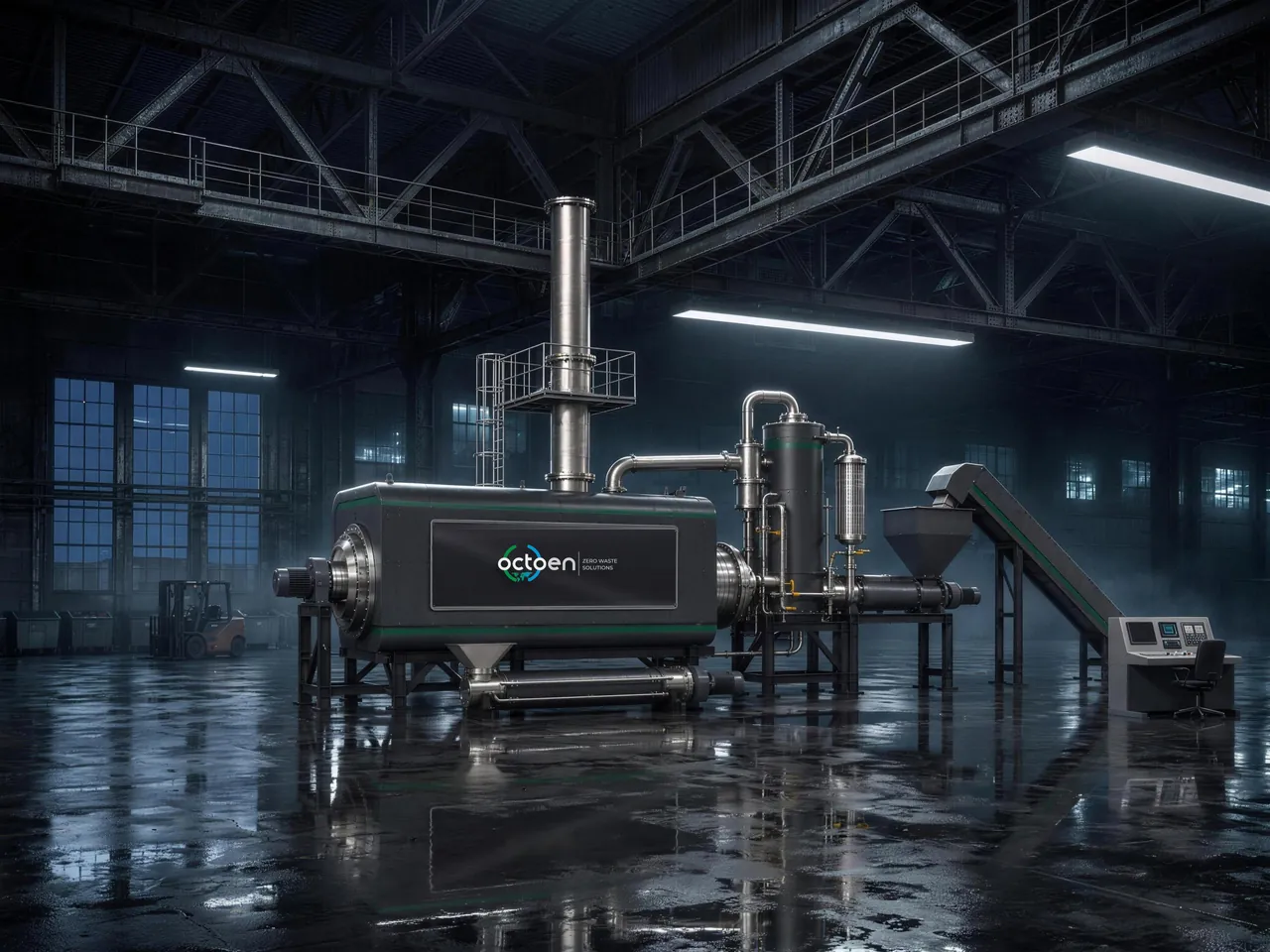
Components
Select a number on the picture or in the list.
Variable-speed geared motor. Sets residence time and quality.
Indirect heating, oxygen-free carbonization. Once started up, heated by burning its own syngas.
Releases treated flue gas. Service platform for safe access.
Water spray scrubs hot flue gas. Removes dust before the chimney.
Safety barrier on the gas line. Prevents flashback to the reactor.
Air-lock feed keeps oxygen out. Steady, metered feed rate.
Inclined, covered belt conveyor. Dust-controlled continuous loading.
Water-cooled screw discharger. Air-lock valve keeps the line sealed.
Touchscreen HMI. Automated process control.
Technical data
Main components
- Drive Unit
- Rotary Pyrolysis Reactor
- Chimney
- Spraying Tower
- Hydroseal (Water Seal)
- Feed Hopper & Screw Feeder
- Enclosed Feed Conveyor
- Biochar Cooling & Discharge
- PLC Control Panel
Specifications depend on the configuration. We share the full technical data with your quote.
Photos and videos
Short videos from real sites. Each model page shows its own.
Technical specification: Continuous Biochar Pyrolysis System
How buying works
- Choose a machinePick a model based on the waste your site produces each day. The system finder can help.
- Add it to your quote listAdd the machine and the options you need. You can add more than one product.
- Request your quoteSend the list. We confirm the configuration, the site voltage and the delivery.
- Delivery and start-upWe plan delivery, installation and training with your team.
Frequently asked questions
All questions on the resources pageWarranty, service and delivery
What warranty do the machines have?
A 12-month limited warranty. The exact terms are set in your written quote.
Who installs the machine and trains our team?
We plan installation, commissioning and user training with you; in the US these services are quoted separately. For the ECO-30, installation and training are done remotely.
Where do you have service?
OCTOEN has direct operations in the US and Türkiye, and assembly, installation and service facilities in Chicago, Peru and Chile.
How long does delivery take?
Lead times are confirmed per project in your quote. The ECO-5000 line has a production lead time of 90 days. Fast door-to-door shipping with FedEx or DHL is available for the ECO-30 to ECO-500 KSN.
Are the machines certified?
CE certified; manufactured with CSA and UL standards in mind. OCTOEN's management systems are certified to ISO 9001, ISO 14001, ISO 45001 and ISO 10002, and its welding to ISO 3834-2.
Didn't find your answer? Ask our team
We'll size the system.
Tell us your daily waste volume. Our engineers review your site, waste stream and power, then send a written quote with the model, footprint, lead time and installation scope.